For most sales teams, this is not a choice between a modern system and an outdated one. SIM calling is often the practical fit for mobile-first outbound work; cloud telephony is usually stronger when calls must enter through one business number and be routed across a team. The right answer depends on the job each call needs to do.
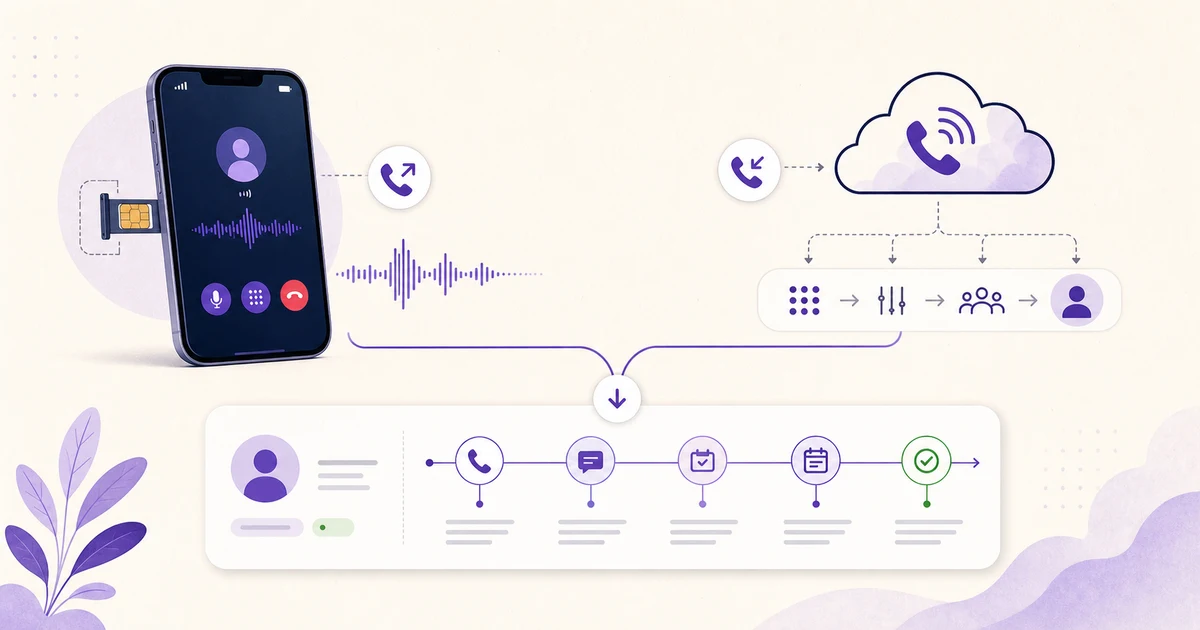
SIM calling vs cloud telephony: quick comparison
| Question | SIM-based calling | Cloud telephony |
|---|---|---|
| Usually strongest fit | Outbound sales, follow-ups, mobile reps | Inbound, IVR, support, queues |
| Rep works from | Mobile phone and SIM | Browser, softphone, or routed business number |
| Shared inbound number | Limited; not the core strength | Strong |
| IVR and queue routing | Usually limited | Strong |
| Call recording | Device and configuration dependent | Usually central at platform level |
| AI analysis | Possible when supported audio or transcripts are available | Possible when audio or transcripts are available |
| Internet dependency for voice | Uses the cellular voice network | Depends on provider and telephony architecture |
| Number reputation concentration | Usually spread across rep numbers | Often concentrated on shared numbers |
| Customer-number masking | Harder with ordinary SIM calling | Usually the better fit |
| Best answer for many teams | Use where it fits | Use where it fits |
Where SIM calling fits better
SIM calling is primarily a workflow choice: the rep calls from a mobile-first sales setup instead of forcing every conversation through a central telephony desk. It suits teams whose day is built around individual owners calling new leads, following up, travelling, or working from the same Android phone they already use.
That can make SIM based calling for sales teams a practical option when the operating model is outbound and rep-led. It does not make an ordinary 10-digit number a compliance shortcut. Cold and warm outreach still needs an appropriate, lawful setup and process under applicable Indian telecom and customer-preference rules.
Where cloud telephony fits better
If the problem is “who should answer this incoming call?” rather than “which rep should call this lead?”, cloud telephony usually has the more natural architecture. One published business number can feed an IVR, queue, extension, or routing rule so the right team receives each call.
That central control is useful for support desks, enquiry lines, and structured inbound operations. Cloud telephony for sales teams can also handle outbound work; it is not an inbound-only technology. The trade-off is simply that a shared calling identity, provider configuration, and routing layer become part of the operating model.
What about call recording?
Cloud telephony commonly records calls centrally at the provider or platform layer. Sales call recording on a SIM is also possible, but support depends on the device, operating system, permissions, telephony implementation, and selected configuration. No buyer should assume that every Android or iOS device can record every call.
The useful question is what happens after recording: is the audio attached to the correct customer, can the right managers access it, and are retention and access controls clear? SalesMax can sync supported recordings and calling activity to the customer timeline, subject to the device and calling setup.
What about AI analysis?
AI does not fundamentally care whether a conversation started on a SIM or a cloud telephony channel. It needs usable call audio, a transcript, and enough context to connect the conversation to the correct lead. Once those inputs are available in a supported setup, AI call analysis can create transcripts, summaries, next actions, objection or keyword signals, and material for coaching reviews.
The value comes from turning a call into sales context—not leaving an isolated audio file in another system. Availability and depth of analysis still depend on the recording, integration, AI configuration, and plan selected.
What about spam labels and number reputation?
When many reps place high-volume outbound calls through the same cloud telephony number, more recipients see and report the same identity. If its reputation deteriorates, the effect is concentrated on a central business number. With SIM-based calling, outbound activity is usually distributed across individual rep numbers, so the concentration risk can be lower and one affected number may be simpler to replace operationally.
That is a risk pattern, not a guarantee. A cloud number is not inherently spam-prone, and a SIM is not immune to complaints, caller-identification labels, or restrictions. Calling practices, consent, frequency, customer expectations, provider controls, and regulatory compliance matter in either architecture.
Whichever setup you use, commercial telecalling should comply with applicable TRAI guidelines and telecom regulations.
What about number masking?
If reps must not see customers’ actual phone numbers inside the CRM or while calling, cloud telephony is usually the cleaner solution. The CRM can ask the provider to connect the call while preserving a central business identity and applying routing controls. Exact masking support varies by provider and integration.
With ordinary SIM calling, the destination number generally needs to be available on the rep’s device to place the call. True masking is therefore harder to enforce consistently. If customer-number masking is a hard requirement, cloud telephony is usually the better fit.
Where WhatsApp fits
WhatsApp complements both calling options; it does not replace either. A rep can continue after a call with a summary, approved template where required, quotation, location, or document. The important operational choice is whether that chat remains connected to the same customer, owner, deal, and next action as the call.
SalesMax can place WhatsApp API or coexistence workflows alongside supported SIM and cloud calling setups so the team can move between channels without creating separate customer histories. Consent, templates, and messaging must still follow applicable Meta policies.
SalesMax: you do not have to choose one
Treat SIM calling and cloud telephony as channels. Use SIM workflows where mobile-first outbound makes sense; use cloud telephony where a shared inbound number, IVR, routing, or masking is important; keep WhatsApp alongside both. The lead, call attempt, supported recording, outcome, follow-up, chat, and deal should still belong to one sales workflow.
The better question is not “SIM or cloud?” It is “which channel works best for this call?” SalesMax lets a growing team use both without splitting its sales process across different systems or choosing its CRM around one telephony architecture.
Choose the channel call by call
See how SIM calling, cloud telephony, and WhatsApp can stay in one sales workflow.